
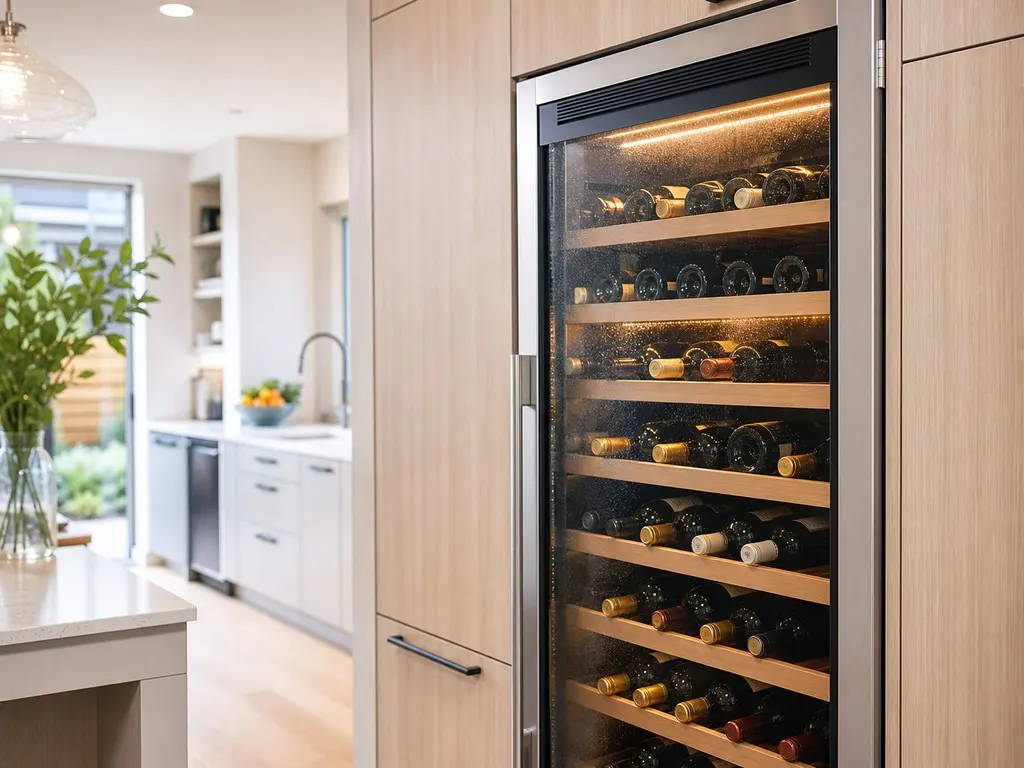
The collectors who call us about wine storage in Milpitas are rarely panicking about a unit that has quit — they are watching a zone read 58 degrees when it should read 54, and they want to know whether that two-or-three-degree drift is worth worrying about. With a built-in Sub-Zero wine column, it is. Wine doesn't fail at a single temperature; it ages badly when it sits a few degrees too warm for months, and a column tucked into the cabinetry of a Milpitas Hills home or a flush install near the Great Mall hides that drift well until a bottle tastes flat.
Sub-Zero builds wine storage — dual-zone columns and undercounter units engineered to hold a steady cellar temperature and humidity. Here is what actually causes the warm drift we see most, and where the line between maintenance and a real repair falls.
Dual zones, two sensors, one drift
A Sub-Zero wine column runs two independent zones — a cooler upper for whites and sparkling, a warmer lower for reds — each with its own thermistor and damper feeding off one sealed system. When only one zone drifts and the other holds, the problem is almost never the compressor; it is the sensor or the damper for that single zone reporting or regulating wrong. We see this constantly in Milpitas: an upper zone that creeps warm while the reds below stay perfect. A failing dual-zone thermistor reads a few degrees off, the control trusts it, and the zone settles at the wrong setpoint without ever throwing an alarm. Confirming which sensor has drifted, against an independent probe, is the first thing we do before anyone touches the sealed system.
Summer heat, a loaded condenser, and a starved evaporator
Milpitas summers push kitchens warm, and a wine column built flush into cabinetry breathes through a grille rather than open air. Dust, lint and pet hair loading that condenser is the single most common reason a healthy column can no longer pull the whole cabinet down on a hot afternoon — both zones drift together, the compressor runs longer and longer, and nothing is actually broken yet. The next stage is airflow inside: an evaporator fan that has worn or iced over stops moving cold air across the zones evenly, so the top shelf reads fine while the door side warms. Keeping the grille genuinely clear does more for a Milpitas wine column than any part we could sell you.
The seals, the UV glass, and the bottles themselves
Two quieter culprits round out the list. A door gasket that has hardened or a misaligned UV-tinted glass door lets warm room air leak in along the edge, so the column fights a small constant heat load and humidity wanders — you'll often see condensation on the inside of the glass before you see it on the thermometer. And vibration matters more here than in a fridge: a compressor mount or a fan starting to buzz transmits a faint tremor through the racks that disturbs sediment in aging reds, which is its own reason to chase down a noise early. None of these is a reason to replace a column.
Repair or replace a Sub-Zero wine column
Sub-Zero wine storage is built to be serviced, and the math almost always favors repair. A drifted thermistor, a loaded condenser, a worn evaporator fan or a tired gasket are all bounded, well-stocked jobs on a unit engineered to run for fifteen-plus years — replacing the whole column to fix a $40 sensor would be a poor trade. The honest exception is a genuine sealed-system leak on a very old unit, where the repair approaches the cost of a new column; we'll tell you plainly when you're there. We measure each zone against a reference probe and check condenser airflow before quoting anything, and the $89 service call goes toward the repair when you book it.