
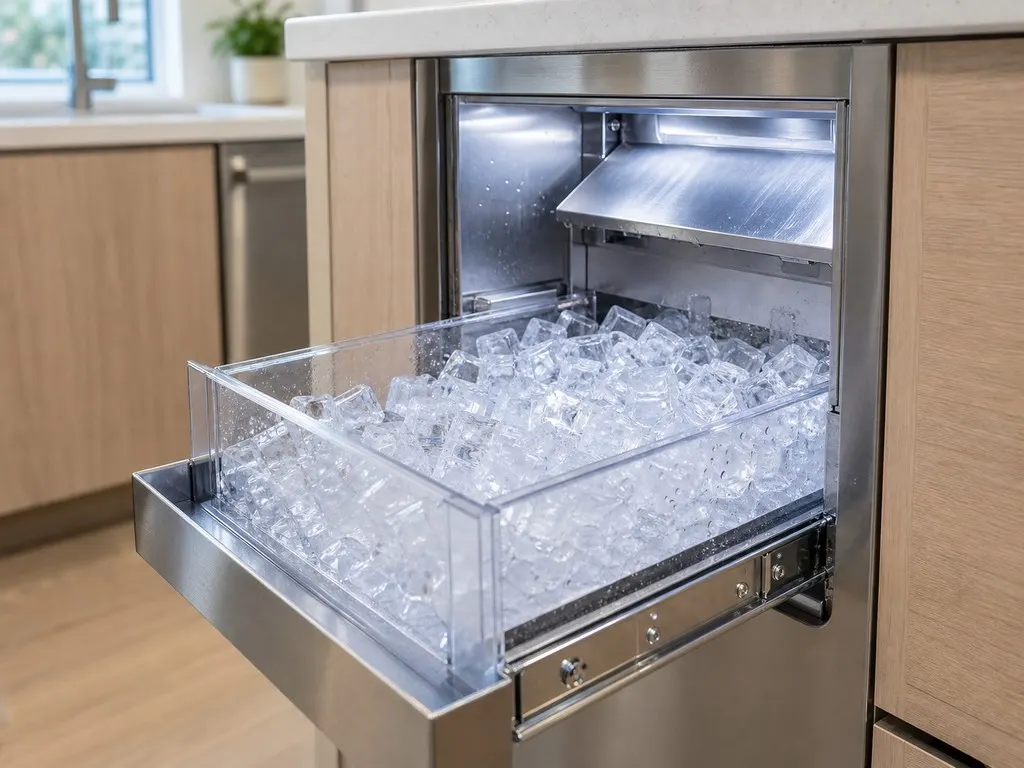
If you live anywhere from McCarthy Ranch to the Sinnott neighborhood, the water coming into your kitchen is on the hard side. Santa Clara County draws a large share of its supply from groundwater and imported sources that run mineral-rich, and the first appliance in the house to complain about it is almost always the ice maker in a built-in Sub-Zero.
Most of the ice-maker calls we run in Milpitas are not a dead module — they are years of dissolved calcium and magnesium quietly building up where you can't see it. Here is what that looks like, and how to keep it from turning into a parts job.
Where the scale actually lands
Hard water doesn't damage an ice maker all at once. It leaves a thin mineral film every time the fill valve cycles, and that film stacks up in three predictable places: the inlet screen behind the fill valve, the small water line feeding the ice mold, and the dispenser chute on door models. As the screen narrows, the mold gets less water, and the first thing you notice is hollow, undersized or cloudy cubes — not a unit that has stopped making ice entirely.
The symptoms in order of appearance
Cubes that look milky or come out smaller than they used to are stage one. Slow ice production and a bin that never quite fills is stage two — the mold simply isn't getting a full charge of water. Stage three is the fill valve straining against the restriction until it sticks or leaks, which is where a cheap maintenance issue becomes a real repair. Catching it at stage one is the whole game.
What helps in a Milpitas kitchen
Run the ice bin down completely every few weeks rather than topping it up — fresh turnover keeps old, mineral-heavy cubes from sitting and clouding. If your home has a whole-house softener, the ice maker benefits directly. And when cube size starts dropping, that is the moment to have the inlet screen and fill valve checked, before scale forces the valve itself. We descale and verify flow with genuine Sub-Zero parts rather than guessing at the module.
Why guessing gets expensive
An ice maker that makes weak ice can be a clogged screen, a starved fill valve, a kinked line, or a worn mold heater — and they look identical from the kitchen. We measure fill volume and inlet pressure before we replace anything, so a $20 restriction never gets diagnosed as a full ice-maker assembly. The $89 service call goes toward the repair if you book it.